The terms get used constantly but rarely explained honestly. Walk into any tailor or menswear shop and you will hear bespoke, made to measure and off the rack suits treated as points on a simple quality scale, when the real differences run much deeper than that. The route you choose affects how the suit is patterned, how much of it is shaped by hand, how well it fits your specific body, and how it holds up over years of wear. This article cuts through the marketing to explain the key differences between bespoke, made-to-measure, and off-the-rack suits, covering how each option is actually built, how it performs on different body types, and what drives the price at each level, so you can quickly work out which path makes sense for your wardrobe, your body and your budget.
How off the rack, made to measure and bespoke suits are actually constructed
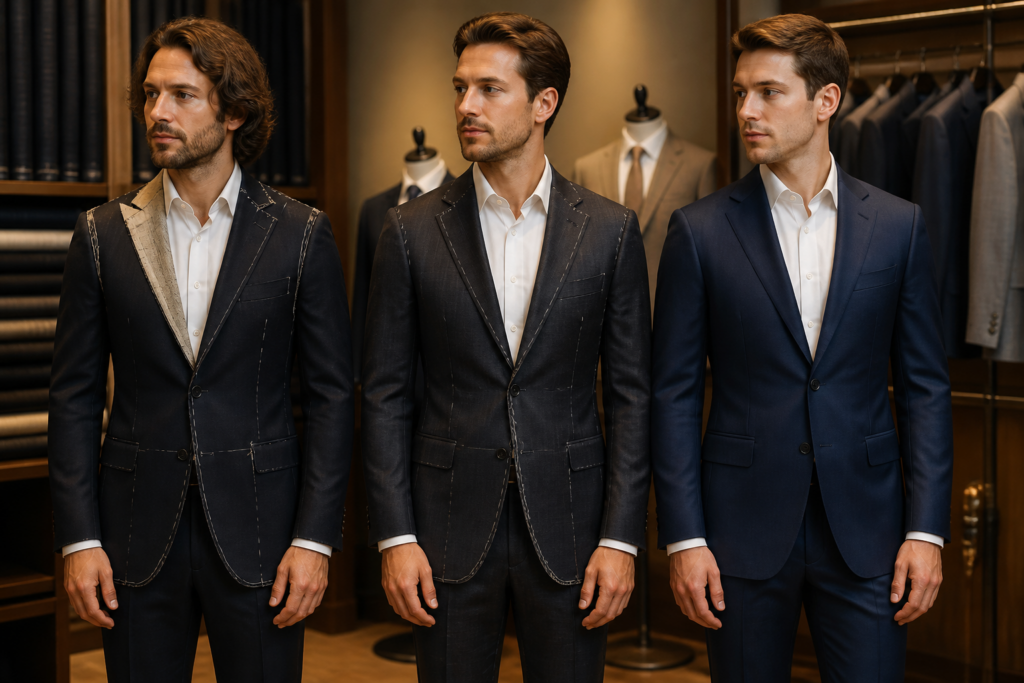
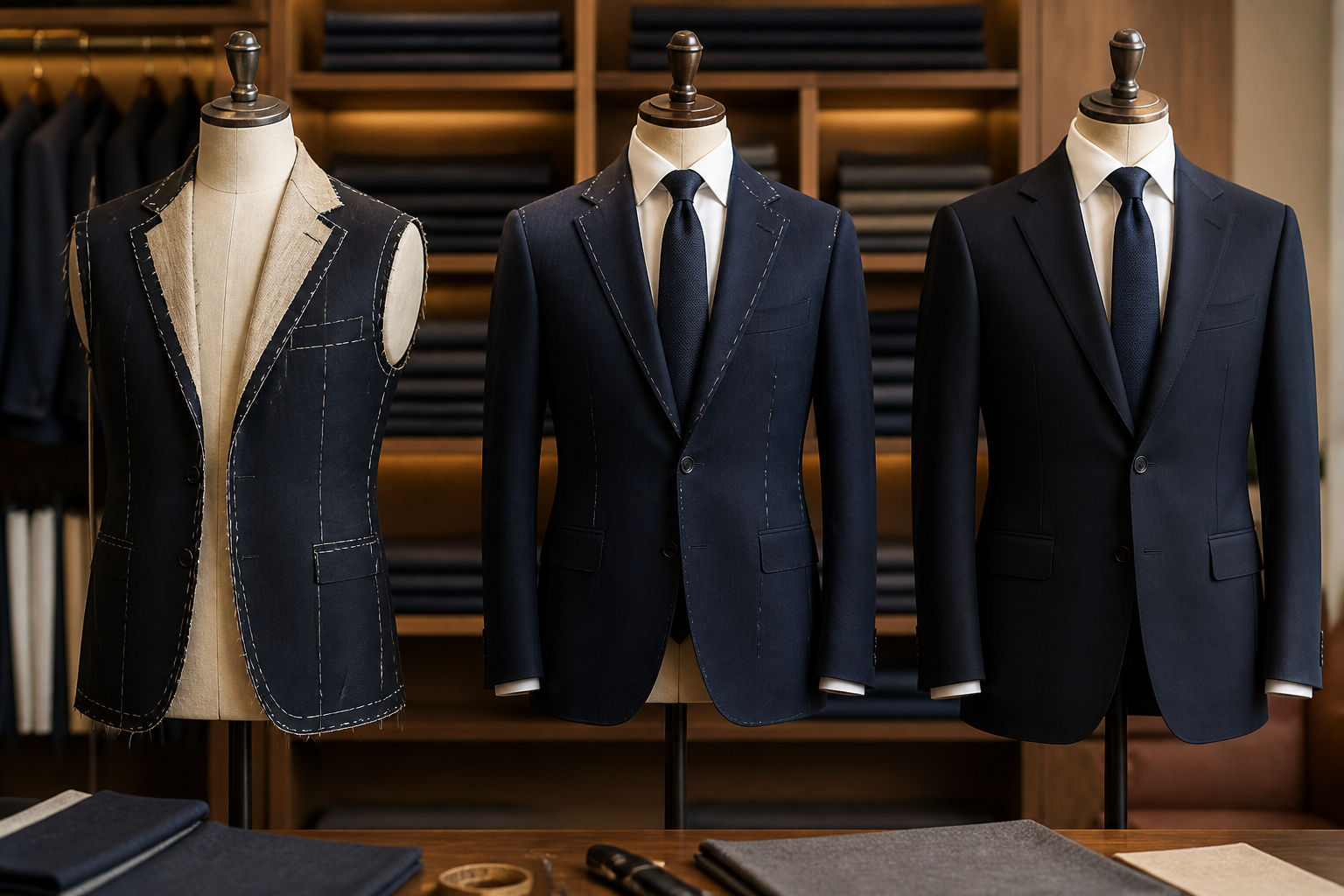
Off the rack suits are mass-produced to fixed sizes, typically labelled by chest measurement and length, such as 38R or 42L. A single standard pattern is graded up and down across those sizes, and the suits are cut and assembled almost entirely by machine before they ever reach the shop floor. There is little or no customisation available, and the construction methods are chosen to keep costs low rather than to maximise drape or durability.
Made to measure starts from a similar base pattern, but that pattern is adjusted to your key measurements before the fabric is cut. The process gives you a meaningfully better starting point for fit, and usually a wider range of style choices: fabric, lapel shape, pocket style, lining. Production is still largely machine-driven and streamlined, which keeps costs lower than bespoke while delivering a noticeably improved result.
Bespoke is built differently from the ground up. A tailor drafts a unique pattern specifically for one person, working from a full set of measurements and often making a shell garment to check the fit before the real cloth is cut. The suit is then assembled and refined through multiple fittings, with a high level of handwork shaping the chest canvas, rolling the lapel and finishing the details. At the most precise end of bespoke, the lapel alone may carry over a thousand hand stitches, which is what allows it to roll and lie naturally rather than sitting flat under pressure.
The key technical differences across all three come down to where the pattern originates, how much of the shaping is done by hand rather than machine, how many fittings take place, and how much skilled time is invested. Those factors are what drive both the price and the final look and feel. Patrick & Co offer both made to measure and full bespoke tailoring, using traditional hand construction in the areas that most affect drape, comfort and longevity. Their bespoke process and fabrics pages explain that in more detail for anyone who wants to go deeper.
How each option fits on different body types
Off the rack sizing is built around a statistical average, so it works reasonably well for men with fairly standard proportions: average height, shoulder width close to the graded norm, and a chest-to-waist drop that matches what the pattern assumes. For everyone else, the compromises show up quickly. A jacket cut to fit your chest will often be too tight across the back or too loose at the waist; the collar may stand away from the neck; sleeves and trouser hems will commonly need shortening. A good alterations tailor can fix length and take in a waist, but they cannot rebuild the shoulder or rebalance the overall structure of the garment, because the underlying pattern remains what it was.
Made to measure removes many of those compromises, since the pattern adjustments happen before the cloth is cut. Sloping or square shoulders can be accounted for, a fuller chest or seat accommodated, and sleeve or trouser length calibrated for longer or shorter limbs, giving most wearers a noticeably cleaner line through the torso. Where made to measure reaches its limits is with stronger asymmetry: one shoulder notably higher than the other, a pronounced stoop, a very sharp drop from chest to waist on an athletic build, or significant postural differences between left and right sides. A fixed base pattern, however well adjusted, has a ceiling when the body departs substantially from the standard.
Bespoke removes that ceiling entirely. Because the pattern is drafted around your individual stance, shoulder angles, arm position and any asymmetry, it can visually straighten a hunched posture, compensate for a lower shoulder and create a balanced silhouette even on bodies that are genuinely difficult to fit. Patrick & Co’s made to measure service covers the needs of most clients with reasonably regular builds who simply want a sharp, clean fit. Their bespoke service becomes particularly valuable for unusual proportions, strong asymmetry, or bodies that change significantly over time.
Body, budget and value: what drives the price of each type of suit
In broad terms, off the rack sits at the entry level, made to measure in the middle, and bespoke at the premium end. Understanding why the prices differ helps you judge where each pound is actually going.
The main cost drivers apply across all three options: the quality of the fabric (its fibre, mill, weight and finish), the level of handwork in the chest and lapels, the construction of the inner canvas and lining, the number of fittings, and how much of the price reflects retail overheads rather than the garment itself. Off the rack prices are partly kept low by scale, but also by the use of synthetic blends and fused interlinings rather than floating canvas, which affects how the suit moves with you and how well it recovers its shape over time.
With made to measure, you pay more upfront, but you gain access to better cloth, a meaningfully improved fit from the first wearing, and significantly fewer alteration costs across the life of the suit. For someone wearing a suit several times a week for work, that adds up quickly. The suit also tends to be built with more resilient construction than its off the rack equivalent at a similar price point.
Bespoke pricing reflects many hours of a skilled tailor’s time: pattern drafting, fitting sessions, hand shaping and finishing. In return you receive a pattern that can be refined and reused, exceptional comfort from a suit that moves with your body rather than against it, and a garment built with enough inlay and structure to be altered and maintained over many years, sometimes decades.
Patrick & Co’s made to measure represents a well-positioned step up for anyone ready to move beyond off the rack without committing to a full bespoke investment. Their bespoke tailoring is intended as a long-term piece for key life roles and significant occasions. Their suits and fabrics pages give specific guidance on where each service sits in terms of budget.
When each option makes sense: everyday wear, business, weddings and special occasions
For occasional wear on a tight budget, a decent off the rack suit with a few targeted alterations can serve perfectly well. The trade-offs are a stiffer hand from the fabric, a tendency to run warmer owing to synthetic content, more creasing after a long day, and a collar gap that photographs tend to catch at the worst moment. None of that is disqualifying if you wear a suit twice a year and the occasion does not demand a flawless silhouette.
For business and frequent wear, made to measure tends to hit the practical sweet spot. The shoulder and collar fit properly from the first wear, which matters across a long day at a desk or in meetings, and better cloth breathes and recovers more reliably so the suit looks presentable at the end of the day as well as the beginning. Over the course of a working wardrobe, the reduction in alteration costs and the longer service life of a well-made suit can offset much of the higher upfront spend.
For weddings and milestone events, the visual stakes are higher because photographs endure. Off the rack can work for guests or groomsmen when budget is the priority, but the groom or principal tends to appreciate the cleaner, more sculpted look that a properly fitted suit provides. Bespoke gives the most precise drape and presence in photographs, with a lapel that rolls naturally and cloth that sits against the body without pulling or twisting. Those are exactly the details a camera picks up.
On comfort and longevity, the differences come down to how the suit is built internally. A floating canvas in the chest flexes as you move rather than resisting it; a hand-rolled lapel holds its shape without pressing. Off the rack suits are also more likely to be cut to current fashion proportions, which can make them harder to reshape or let out as your body or taste shifts. Quality made to measure and bespoke suits from a house like Patrick & Co are built with enough inlay and structural integrity to be altered as you need over many years.
A practical summary: off the rack with alterations is the sensible starting point for a first suit or very occasional use. Patrick & Co’s made to measure is the right step up for professionals, frequent wearers and grooms who want a noticeably tailored look without the time and investment of a full bespoke commission. Patrick & Co’s bespoke is for those who want their best suit, built to last, for a major role or a once-in-a-lifetime occasion.
A practical decision framework: which route is right for you?
Three questions will narrow this down quickly for most people.
1. How often will you wear it? Once or twice a year points towards off the rack plus basic alterations. Monthly wear points to made to measure. Weekly wear makes made to measure or bespoke a genuine long-term saving, not just a luxury.
2. How particular are you about fit? If ‘good enough’ is genuinely acceptable, off the rack can deliver that. If you want the suit to look sharp from every angle, in person and in photographs, you need at least made to measure. If your body shape is challenging or asymmetrical, bespoke is the honest answer.
3. What is your realistic budget? Off the rack is the entry level on cost but carries ongoing alteration and replacement costs. Made to measure costs more upfront and substantially less over time. Bespoke is a long-term investment piece, priced accordingly, but built to be maintained and altered rather than replaced.
A few body-type shortcuts are worth naming directly. If you are very tall or very short, strongly athletic, or if one shoulder sits noticeably higher than the other, you should move up at least one tier from what your budget alone might suggest. Pattern control matters far more for non-standard proportions, and the cost of a poor fit compounds every time you wear the suit.
If you are on the fence between made to measure and bespoke, the most practical step is to start with a made to measure consultation. Trying a properly fitted suit often settles the question, because feeling the difference from off the rack makes it immediately clear whether you want to go further.
For anyone ready to take the next step, Patrick & Co’s showroom experience, bespoke process and fabric library are worth exploring in detail. Booking an appointment gives you the chance to talk through your body type, lifestyle and budget with a tailor who can recommend the right path for your wardrobe, without any pressure to go further than makes sense for you.